Dental Crowns vs Bridges: Which Option Is Right for You?
By Dr. Lynn | GH Goh Dental Surgery, Singapore
One of the questions I often hear from patients is: “Do I need a crown or a bridge?”
The answer depends on what is happening with your teeth.
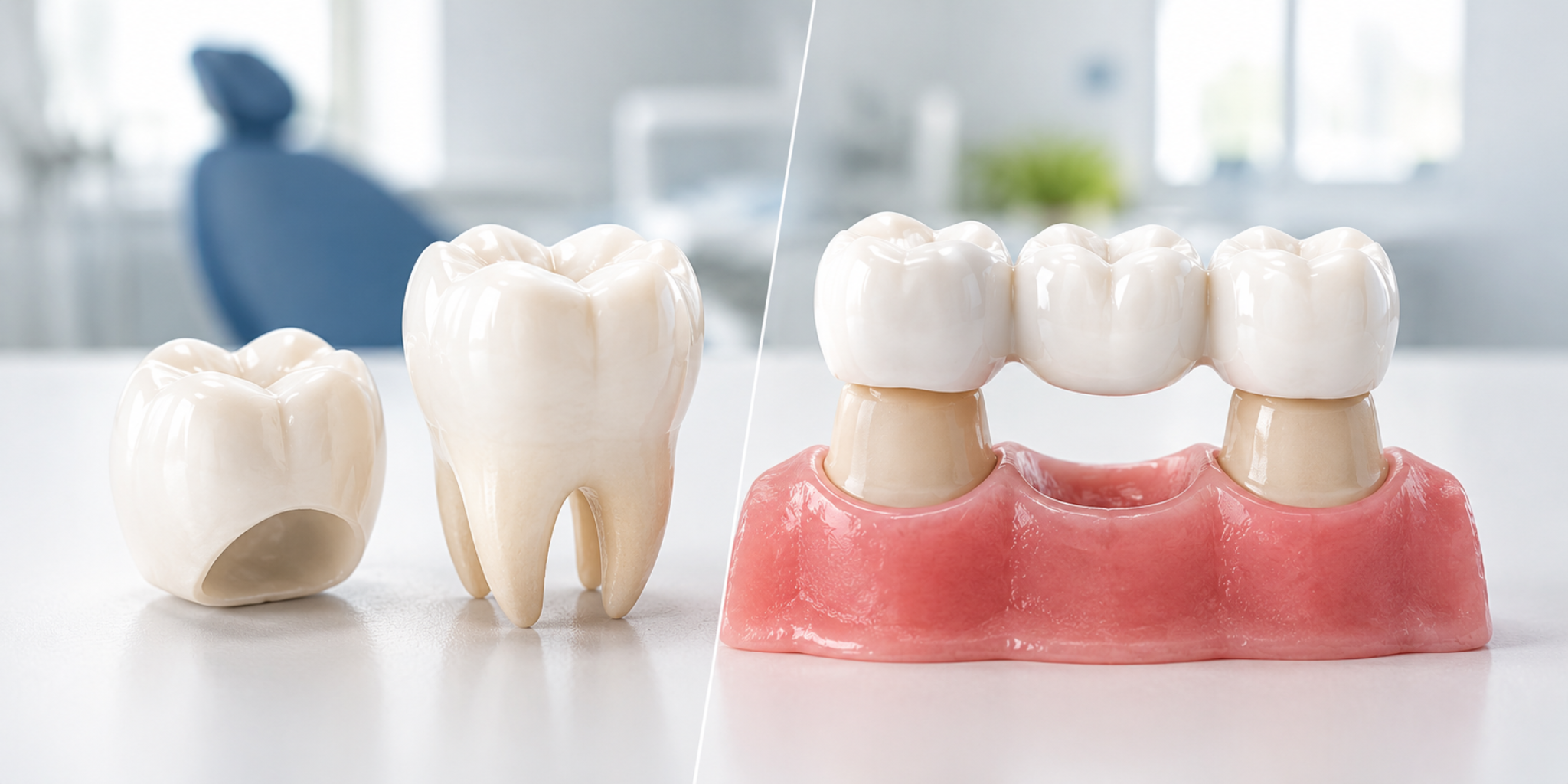
A dental crown and a dental bridge are both restorative treatments, but they are designed to solve different problems. A crown is generally used to restore and protect a tooth that is still present but has become damaged or weakened. A bridge, on the other hand, can be used to replace one or more missing teeth.
If you have a damaged tooth or a gap in your smile, it is natural to want to know which option is best. In this article, I want to explain the difference between crowns and bridges, when each may be considered, and how we determine which treatment is most suitable for you.
What Is a Dental Crown?
A dental crown is a custom-made restoration that fits over an existing tooth.
Think of it as a protective covering for a tooth that has lost some of its strength or structure. Once fitted, a crown can help restore the tooth’s function while also improving its appearance.
A crown may be considered when a tooth has been:
- Significantly weakened by decay
- Damaged or fractured
- Heavily restored with a large filling
- Weakened following certain dental treatments
- Structurally compromised and in need of additional protection
The goal is not simply to make the tooth look better. A well-designed crown should help restore strength, function, comfort, and a natural appearance.
Of course, not every damaged tooth automatically needs a crown. During an examination, we first need to assess how much healthy tooth structure remains and whether the tooth can be predictably restored.
What Is a Dental Bridge?
A dental bridge is a restoration designed to replace one or more missing teeth.
Instead of leaving a gap, a bridge uses supporting teeth or dental implants to hold a replacement tooth or teeth in position. This can restore the appearance of your smile and help improve chewing and speaking.
However, a bridge is not automatically the right solution for every missing tooth.
We need to look at the condition of the surrounding teeth, your gums, your bite, and your overall oral health before deciding whether a bridge is suitable.
There may also be other treatment options depending on your individual circumstances. This is why a proper dental assessment is important before deciding on any restoration.
Dental Crown vs Bridge: What Is the Difference?
The simplest way to understand the difference is this:
“A crown restores a tooth that is still present”.
“A bridge replaces a tooth that is missing”.
Here is a simple comparison:
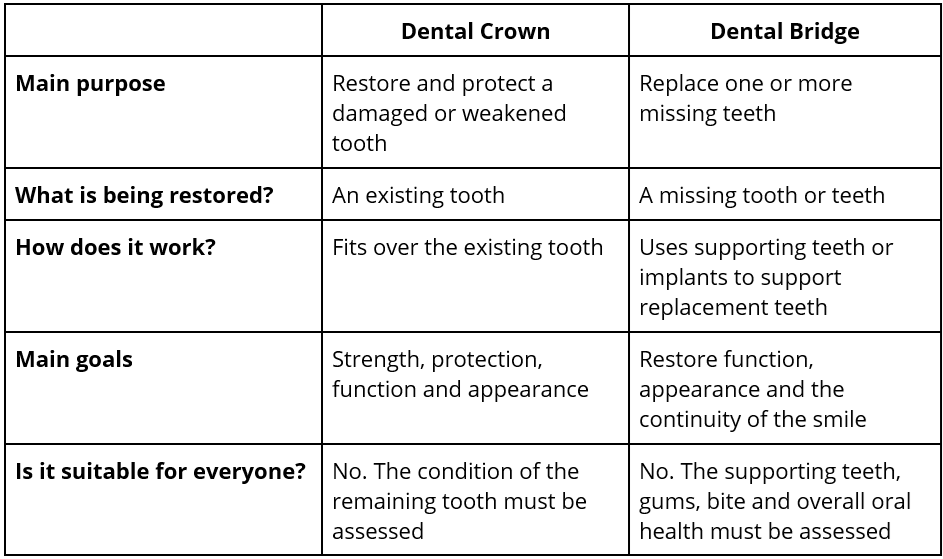
So, it is not really a question of whether a crown is “better” than a bridge.
They are designed for different situations.
When Might a Dental Crown Be Recommended?
A crown may be recommended when there is still a tooth to restore, but that tooth has become too weak or damaged to function reliably without additional protection.
For example, a tooth with significant structural damage may benefit from a crown to help restore its shape and function.
A crown may also be considered when a tooth has undergone extensive treatment and needs additional support.
During your consultation, we will look at the condition of the tooth and surrounding tissues before deciding whether a crown is appropriate.
The aim is always to preserve and restore your natural tooth where possible, rather than recommending a treatment simply because it is available.
When Might a Dental Bridge Be Considered?
A bridge may be considered when one or more teeth are missing and the surrounding conditions make a bridge an appropriate restoration.
For a bridge to work well, the supporting structures need to be suitable. We therefore consider factors such as:
- The health and strength of the supporting teeth
- The condition of your gums
- Your bite and how your teeth come together
- The location and size of the missing tooth space
- Your overall oral health
- Your functional and aesthetic needs
A bridge is therefore not simply a matter of “filling the gap”. The supporting structures and the long-term health of your mouth need to be considered as part of the treatment plan.
What About Appearance?
For many patients, restoring a tooth is not only about being able to chew comfortably. You also want the restoration to look like it belongs in your smile.
Modern dental restorations can be designed to achieve a natural-looking appearance by considering factors such as the shape, colour, size, and position of the surrounding teeth.
At GH Goh Dental Surgery, our crowns and bridges are custom-made with the aim of achieving a comfortable fit and natural appearance.
The material selected may also vary depending on your clinical needs and aesthetic goals. Depending on the treatment plan, options may include porcelain or zirconia restorations.
The right material is not necessarily the same for every patient, which is why we assess the individual tooth and your overall needs before making a recommendation.
How Do We Decide Which Option Is Right for You?
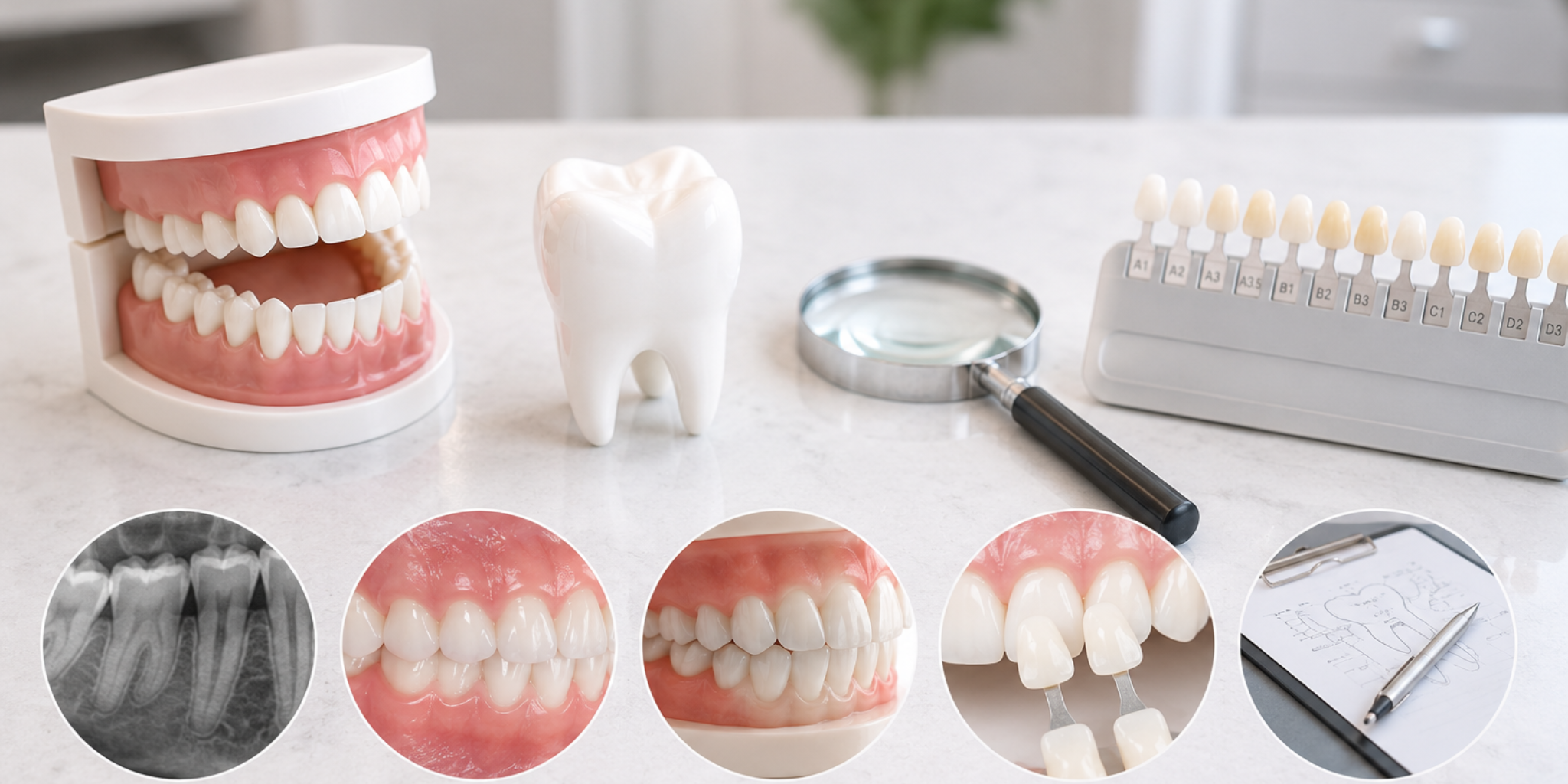
This is where a dental consultation becomes important.
There is no single restoration that is automatically right for everyone. Before recommending a crown or bridge, we consider several factors.
- The Condition of Your Tooth
- The Condition of the Surrounding Teeth
- Your Gum Health
- Your Bite
- Your Aesthetic Goals
- Your Overall Oral Health
The goal is to choose a restoration that is appropriate for your clinical needs while also considering comfort, function and appearance.
What Is the Treatment Process Like?
We assess your oral health, examine the affected tooth or missing tooth area, and discuss the available treatment options.
Step 2: Tooth Preparation
If a crown or bridge is suitable, the supporting tooth or teeth are carefully prepared. Impressions or digital scans may then be taken as part of the restoration process.
Step 3: Custom Fabrication
Your crown or bridge is custom-made to achieve an accurate fit and natural appearance.
Step 4: Fitting and Adjustments
Once the restoration is ready, it is carefully fitted. Adjustments can be made where necessary to ensure the restoration feels comfortable and functions properly.
Step 5: Ongoing Care
Your restoration still needs regular care. Good oral hygiene and routine dental check-ups are important for maintaining the health of your natural teeth and the longevity of the restoration.
How Long Do Crowns and Bridges Last?
There is no single lifespan that applies to every crown or bridge.
How long a restoration lasts can depend on factors such as:
- Your oral hygiene
- Your bite
- The condition of the supporting teeth
- Your diet and habits
- The type and quality of restoration
- Regular dental care
This is why looking after the teeth supporting a restoration is just as important as caring for the restoration itself.
Regular dental examinations allow us to monitor the restoration and identify any concerns early.
Frequently Asked Questions
Is a crown the same as a bridge?
No. A crown is designed to restore and protect an existing tooth, while a bridge is designed to replace one or more missing teeth using supporting teeth or implants.
Will my crown or bridge look natural?
A well-designed restoration can be made to complement your surrounding teeth in terms of colour, shape and appearance. Your dentist will consider your aesthetic goals when planning the restoration.
How many appointments are needed?
The number of appointments depends on your individual treatment plan and the type of restoration required. During your consultation, we can explain the expected process and timeline for your specific case.
What materials are used for crowns and bridges?
Different materials may be suitable depending on the location of the tooth, functional requirements, aesthetic goals and your overall treatment plan. Depending on the case, porcelain or zirconia restorations may be considered.
Does getting a crown hurt?
The treatment is performed with appropriate local anaesthesia to keep you comfortable. You may experience some sensitivity or tenderness afterwards, but your dentist will provide guidance on what to expect during your recovery.
How do I know whether I need a crown or a bridge?
The best way to determine this is through a dental examination. A crown is generally considered when an existing tooth needs restoration or protection, while a bridge may be considered when one or more teeth are missing. Your dentist will assess your individual oral health before recommending the most suitable option.
A Final Word from Dr. Lynn
When you have a damaged or missing tooth, it is understandable to want a straightforward answer about which treatment you should choose.
But in dentistry, there is rarely a one-size-fits-all solution.
A crown and a bridge serve different purposes, and the right choice depends on the condition of your teeth, your oral health, your bite, your functional needs and your aesthetic goals.
Our priority is always to understand what your smile needs first and then recommend the most appropriate treatment based on your individual situation.
If you have a damaged, weakened, or missing tooth and are unsure about your options, please do not feel that you need to make the decision yourself. A consultation gives us the opportunity to assess your teeth properly and explain the options available to you.
At GH Goh Dental Surgery, we aim to provide personalised treatment in a comfortable and welcoming environment, so you can make an informed decision about your dental care.
Keep brushing, keep flossing, and never hesitate to reach out.
— Dr. Lynn, GH Goh Dental Surgery
Ready to Take the Next Step?
If you have a damaged, weakened, or missing tooth and would like to understand which restorative option may be suitable for you, we are here to help.
Book a consultation with GH Goh Dental Surgery to discuss your dental needs and explore the most appropriate treatment for your smile.
📍 161 Bukit Merah Central, Singapore
📞 +65 6273 3133
💬 WhatsApp us to book your appointment
@gh.goh.dental